How Resin Cast Construction Enhances Current Transformer Reliability
Electrical power systems depend on accurate current measurement for monitoring, protection, metering, and equipment control. Current transformers (CTs) play an important role in these systems by reducing high currents to measurable levels that can be safely handled by meters and protective devices. However, the reliability of a CT depends on much more than its electrical ratio. Insulation quality, mechanical strength, environmental resistance, thermal performance, and construction all influence how consistently it performs.
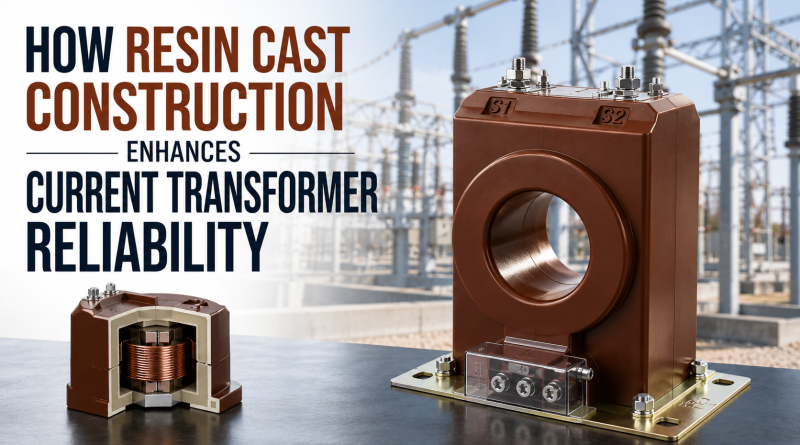
A Resin Cast Current Transformer uses an encapsulated insulation system in which the active electrical components are surrounded by insulating resin. This construction provides mechanical support and electrical insulation while protecting important internal components from several environmental influences. As a result, resin cast technology is widely considered for industrial and commercial electrical installations where dependable measurement and protection are important.
Understanding how resin cast construction contributes to reliability can help engineers, electrical contractors, and facility managers make better decisions when selecting CTs for their systems.
What Is a Resin Cast Current Transformer?
A Resin Cast Current Transformer is a type of instrument transformer in which the core and winding assembly is encapsulated within an insulating resin material. The resin forms a solid insulating body around the internal components instead of relying on liquid insulation.
The basic purpose remains the same as other current transformers: the CT transforms a high primary current into a lower secondary current suitable for measurement or protection equipment.
Depending on its design and application, a CT may be used for:
- Electrical metering
- Protection systems
- Power monitoring
- Overcurrent protection
- Earth fault protection
- Energy management
- Industrial control systems
- Switchgear and distribution equipment
The resin encapsulation provides additional structural and insulation-related advantages that can be particularly valuable in demanding electrical environments.
How Does Resin Casting Improve CT Reliability?
The reliability benefits of resin casting come from the way the internal components are physically supported and electrically insulated. Several characteristics make this construction suitable for applications where consistent performance is required.
1. Strong Electrical Insulation
Insulation is one of the most important aspects of any current transformer. The insulation system must withstand the electrical stresses present during normal operation as well as certain abnormal conditions.
In a resin cast design, the insulating resin surrounds the internal electrical components and creates a solid insulation barrier. Proper encapsulation can help maintain separation between conductive parts and reduce the possibility of insulation-related problems.
This is particularly important in equipment installed close to other electrical components where dependable insulation performance is essential.
2. Protection Against Moisture and Contaminants
Electrical equipment installed in industrial environments can be exposed to humidity, dust, dirt, and other contaminants. Moisture and contamination can negatively affect insulation performance if sensitive components are not adequately protected.
Resin encapsulation provides a physical barrier around the core and winding assembly. This helps protect internal components from direct exposure to environmental contaminants.
For installations where environmental conditions are difficult to control, this protective construction can contribute to longer and more consistent service performance.
3. Improved Mechanical Stability
A CT contains internal components that need to remain properly positioned throughout its operating life. Mechanical movement or vibration can be undesirable, particularly in industrial installations.
Once the internal assembly is encapsulated in resin, the components are supported within a solid structure. This can improve mechanical stability and reduce unwanted movement caused by vibration or external mechanical influences.
The result is a robust construction that can be suitable for industrial electrical equipment where mechanical durability is important.
Resin Cast Construction and Thermal Performance
Current transformers generate heat during operation because of electrical losses in their windings and magnetic core. Proper thermal management is therefore important for maintaining reliable performance.
The design of the CT, conductor arrangement, core material, winding configuration, resin characteristics, and surrounding installation conditions all influence thermal performance.
A properly designed resin cast CT can provide a stable encapsulated structure while allowing heat to be managed according to the manufacturer’s specified operating conditions.
Engineers should always consider the rated current, burden, accuracy requirements, ambient temperature, and installation conditions when selecting a CT. Resin construction alone does not guarantee thermal performance; the complete CT design must be evaluated.
Resistance to Harsh Industrial Conditions
Industrial electrical installations may operate in environments where equipment is exposed to vibration, dust, humidity, temperature variations, and other demanding conditions.
A solid resin-encapsulated structure can provide useful protection for internal electrical components. Unlike designs that depend on liquid insulation, resin cast construction uses a solid insulation system.
This can make the CT practical for a variety of indoor electrical installations and industrial applications where environmental protection is an important consideration.
However, the suitability of a particular CT should always be determined according to its specified environmental ratings and installation requirements.
Accuracy Is Critical in Current Transformers
Reliability is not only about physical durability. A current transformer must also provide dependable electrical performance.
CT accuracy is important in both measurement and protection applications. Metering CTs may be used for energy measurement and monitoring, while protection CTs provide current information to protective relays during abnormal operating conditions.
The appropriate CT should therefore be selected according to factors such as:
- Transformation ratio
- Accuracy class
- Burden
- Rated frequency
- Insulation level
- Thermal rating
- Short-time current rating
- Application requirements
A well-designed Resin Cast Current Transformer can provide the stable construction required for accurate and reliable current measurement when properly specified for the application.
Role of Resin Cast CTs in Protection Systems
Current transformers are essential components of many electrical protection systems. Protective relays depend on CT signals to identify abnormal current conditions and initiate appropriate protective actions.
For example, CTs may be incorporated into overcurrent, differential, earth fault, and other protection arrangements.
A CT used for protection must be selected according to the requirements of the protective system. Accuracy during fault conditions, saturation characteristics, ratio, and burden are particularly important considerations.
This is why choosing the correct CT should involve more than simply selecting a physical size or current ratio.
Core Balance CT for Earth Fault Protection
A Core Balance CT for Earth Fault Protectionis designed specifically to detect residual or leakage current associated with an earth fault.
In a core balance arrangement, the conductors of the electrical circuit pass through the CT core. Under normal balanced conditions, the vector sum of the currents is approximately zero. When an earth fault occurs, part of the current can flow through an unintended path to earth, creating an imbalance.
The core balance CT detects this residual current and provides a signal to the associated protection device.
This makes core balance CTs useful in applications where sensitive earth fault detection is required.
Why Is Core Balance Construction Useful?
A core balance CT can provide a convenient method of monitoring residual current because multiple conductors can pass through a single magnetic core.
Depending on the system design, it may be used in:
- Industrial distribution systems
- Motor protection
- Switchboards
- Control panels
- Power distribution equipment
- Earth leakage monitoring systems
- Electrical protection installations
The correct CT ratio, sensitivity, installation arrangement, and relay settings should be determined according to the protection system requirements.
Choosing a Reliable Current Transformer
Selecting a CT should begin with understanding the electrical and physical requirements of the installation. Important factors include the primary current, secondary current, accuracy requirements, burden, frequency, insulation requirements, and intended application.
For protection systems, engineers should also consider the expected fault current and CT performance during fault conditions.
Environmental conditions are equally important. If the CT will be installed in an environment with humidity, dust, vibration, or temperature variation, its construction and ratings should be suitable for those conditions.
A reputable Industrial Current Transformer Manufacturer can help customers select an appropriate CT based on the electrical specifications and application requirements.
Why Manufacturer Quality Matters
The construction quality of a current transformer can significantly influence its long-term performance. Resin quality, winding technique, core selection, insulation design, encapsulation process, dimensional accuracy, and testing procedures all matter.
An experienced Industrial Current Transformer Manufacturer should have appropriate quality-control and testing processes to verify that products meet their specified electrical and mechanical characteristics.
Depending on the product and application, testing may cover electrical insulation, ratio accuracy, winding resistance, polarity, and other relevant characteristics.
For critical electrical installations, selecting a manufacturer with suitable technical expertise and quality-assurance practices can be an important part of equipment selection.
Applications of Resin Cast Current Transformers
Resin cast CTs can be used across a wide range of electrical installations. Their compact and solid construction makes them suitable for applications where dependable insulation and mechanical stability are required.
Common application areas include:
Industrial Plants
Factories use CTs for electrical monitoring, metering, protection, and energy management. Resin cast construction can be suitable for industrial switchgear and control equipment when the product ratings match the installation.
Power Distribution
Distribution systems require accurate current measurement for monitoring and protection. CTs can provide current signals to meters and protective relays.
Control Panels and Switchboards
Compact CT designs can be incorporated into electrical panels where space and insulation requirements need to be considered.
Motor Protection
Industrial motors can require current monitoring and protection against abnormal operating conditions. Properly selected CTs can provide current information to protective devices.
Earth Fault Protection
Core balance CTs can be used with appropriate protective relays to detect residual current and support earth fault protection schemes.
Maintenance Considerations
Although resin cast CTs are designed for dependable operation, regular electrical-system inspection remains important.
Maintenance teams should check for visible damage, loose connections, overheating, contamination around accessible surfaces, and other signs of abnormal operation. Electrical testing should be performed according to the equipment manufacturer’s recommendations and the requirements of the installation.
Any abnormal temperature rise, unusual noise, insulation damage, or unexpected protection-system behavior should be investigated by qualified electrical personnel.
Proper installation is equally important. Incorrect wiring, unsuitable burden, loose connections, or improper grounding can affect CT performance regardless of its construction type.
Final Thoughts
Resin cast construction can enhance current transformer reliability by providing strong electrical insulation, mechanical stability, and protection of internal components from environmental influences. These characteristics make a Resin Cast Current Transformer a practical option for many industrial and commercial electrical applications.
At the same time, reliable CT performance depends on the complete design—not simply the use of resin. Ratio, accuracy class, burden, insulation level, thermal characteristics, fault performance, installation conditions, and manufacturing quality should all be considered.
For earth fault protection applications, a Core Balance CT for Earth Fault Protection can provide an effective method of detecting residual current when correctly integrated with the protection system.
Ultimately, working with an experienced Industrial Current Transformer Manufacturer can help ensure that the selected CT matches the electrical, environmental, and protection requirements of the installation. A properly specified and manufactured CT can contribute to accurate measurement, dependable protection, and stable operation of modern electrical systems.
FAQs
1. What is a Resin Cast Current Transformer?
A Resin Cast Current Transformer is an instrument transformer in which the core and winding assembly is encapsulated in insulating resin. This solid insulation provides electrical isolation, mechanical support, and protection for internal components.
2. How does resin casting improve CT reliability?
Resin casting can improve reliability by providing strong insulation, mechanical stability, and protection against moisture, dust, and other environmental influences. It also helps maintain the structural integrity of the internal components.
3. Where are Resin Cast Current Transformers commonly used?
They are commonly used in industrial plants, switchboards, control panels, power distribution systems, metering installations, motor protection systems, and electrical protection equipment.
4. Are Resin Cast Current Transformers suitable for industrial applications?
Yes. Their solid encapsulated construction can make them suitable for many industrial environments where dependable insulation, mechanical strength, and reliable current measurement are required.
5. What factors should be considered when selecting a Resin Cast Current Transformer?
Important factors include transformation ratio, accuracy class, burden, rated frequency, insulation level, thermal rating, short-time current rating, installation conditions, and whether the CT is intended for metering or protection.
6. What is a Core Balance CT for Earth Fault Protection?
A Core Balance CT for Earth Fault Protection detects residual or imbalance current in an electrical circuit. During an earth fault, the resulting current imbalance can be detected by the CT and communicated to an appropriate protective relay.
7. Why is accuracy important in a current transformer?
CT accuracy is important because meters and protective relays depend on the current signal supplied by the transformer. The required accuracy class depends on whether the CT is being used for metering, monitoring, or protection.
8. Can Resin Cast CTs be used for earth fault protection?
Yes, appropriately designed CTs can be incorporated into earth fault protection systems. A core balance arrangement is commonly used for detecting residual current, but the CT specifications and protection settings must match the system requirements.