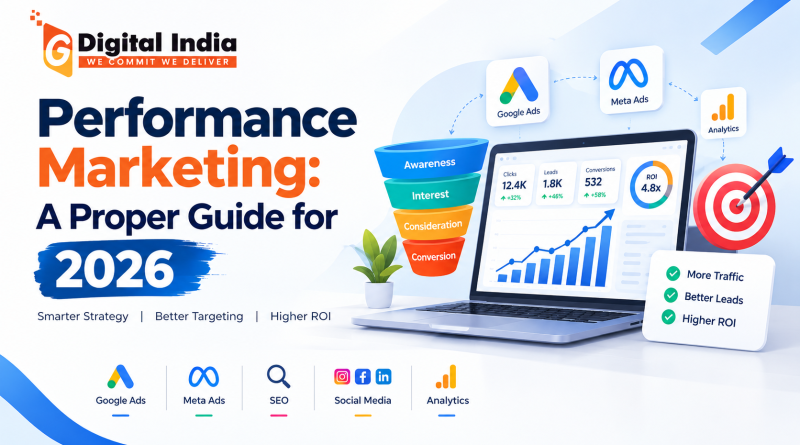
Performance Marketing: A Proper Guide for 2026
Digital marketing has changed significantly in recent years. Businesses are no longer looking only for website visits, social media likes, or impressions. They want measurable outcomes such as qualified leads, sales, app installs, enquiries, and revenue. This is where performance marketing becomes important.
Performance marketing is a results-focused approach where advertising campaigns are planned, tracked, measured, and optimized according to specific business goals. Instead of simply spending money to increase visibility, businesses can monitor how their campaigns perform and make decisions based on real data.
For businesses working with a Digital Marketing Agency in Jaipur, performance marketing can be especially useful for building measurable online campaigns across search engines, social media platforms, display networks, and other digital channels.
What Is Performance Marketing?
Performance marketing is a digital advertising strategy based on measurable actions. These actions can include clicks, leads, purchases, registrations, downloads, or other conversions.
The basic idea is simple: businesses define what they want to achieve, launch campaigns designed around that objective, track the results, and continuously optimize their advertising efforts.
For example, an e-commerce company may focus on completed purchases, while a service-based business may measure qualified enquiries or phone calls. This makes performance marketing flexible for different industries and business models.
How Does Performance Marketing Work?
A successful campaign usually follows a structured process:
- Define the objective:
The first step is deciding what the campaign should accomplish. This could be generating leads, increasing sales, attracting website visitors, or improving brand conversions. - Identify the target audience:
Businesses need to understand who their ideal customers are, what they search for, what problems they have, and which platforms they use. - Select the right channels:
Search advertising, social media advertising, display campaigns, shopping ads, remarketing, and other channels can be selected according to the audience and business goal. - Launch the campaign:
Ad creatives, landing pages, audience targeting, keywords, bidding strategies, and tracking systems are prepared before the campaign goes live. - Measure the results:
Important metrics such as clicks, conversion rate, cost per lead, cost per acquisition, return on ad spend, and revenue help determine campaign effectiveness. - Optimize continuously:
Underperforming ads can be paused, successful audiences can receive more budget, and landing pages can be improved based on campaign data.
Why Is Performance Marketing Important in 2026?
Competition online is increasing across almost every industry. Businesses need more than visibility; they need marketing activities that can demonstrate measurable business value.
Performance marketing helps companies understand where their budget is going and what results it is generating. This makes it easier to identify successful campaigns and reduce unnecessary spending.
It also supports faster decision-making. Instead of waiting months to understand whether a campaign is working, marketers can monitor performance regularly and make adjustments based on current data.
A Performance Marketing Agency in Jaipur can help businesses combine campaign strategy, audience targeting, analytics, creative testing, and conversion optimization to create a more structured advertising process.
Performance Marketing vs Traditional Digital Marketing
Traditional digital marketing can include activities focused on awareness, visibility, engagement, and long-term brand growth. These activities are valuable, but their results may not always be directly connected to revenue.
Performance marketing places greater emphasis on measurable outcomes.
For example, rather than simply asking how many people saw an advertisement, marketers may ask:
- How many people clicked the advertisement?
- How many visitors completed the desired action?
- What was the cost of acquiring each customer?
- Which campaign generated the highest revenue?
- Which audience produced the best conversion rate?
This results-oriented approach makes performance marketing particularly useful for businesses with clearly defined conversion goals.
Major Channels Used in Performance Marketing
Search Engine Advertising
Search advertising allows businesses to reach people actively searching for relevant products or services. Campaigns can target specific search terms, locations, devices, audiences, and other factors.
Social Media Advertising
Platforms such as Facebook, Instagram, LinkedIn, and other social networks allow advertisers to reach users based on demographics, interests, behaviours, professional information, and previous interactions.
Display Advertising
Display campaigns use visual advertisements across websites and digital platforms. They can be useful for building awareness, reaching new audiences, and running remarketing campaigns.
Remarketing
Remarketing targets people who have already interacted with a business. For example, someone who visited a product page but did not purchase may later see an advertisement encouraging them to return.
Shopping and E-commerce Campaigns
Online stores can use product-focused advertising to showcase products to users who are actively researching or purchasing similar items.
What Metrics Should You Track?
Tracking the right metrics is one of the most important parts of performance marketing. Some commonly monitored indicators include:
Click-Through Rate (CTR): Measures how frequently users click an advertisement after seeing it.
Conversion Rate: Shows the percentage of visitors who complete a desired action.
Cost Per Lead (CPL): Indicates how much advertising spend is required to generate a lead.
Cost Per Acquisition (CPA): Measures the average cost of acquiring a customer or conversion.
Return on Ad Spend (ROAS): Compares advertising revenue with advertising expenditure.
Customer Acquisition Cost (CAC): Helps businesses understand the overall cost involved in acquiring customers.
These metrics should not be analyzed individually. A campaign with a low cost per click may still be unsuccessful if it generates poor-quality leads.
How SEO and Performance Marketing Work Together
Performance advertising and SEO are different strategies, but they can support each other.
Paid campaigns can generate immediate visibility, while SEO can help businesses build long-term organic presence. If a business experiences an organic traffic drop, paid campaigns can sometimes help maintain visibility while the underlying SEO problem is investigated.
At the same time, SEO data can provide valuable information about customer search behaviour. Search terms that generate conversions through advertising may provide useful insights for future organic content.
Businesses should therefore look at both paid and organic channels rather than treating them as completely separate marketing activities.
The Role of Website Performance
Advertising cannot solve every conversion problem. If users click an advertisement but encounter a slow or difficult website, the campaign may struggle to produce results.
Issues such as website speed issues, poor mobile usability, confusing navigation, weak calls to action, or complicated forms can negatively affect conversions.
This is why website performance monitoring should be part of a broader digital marketing strategy. Marketers should regularly evaluate page speed, mobile experience, landing-page engagement, conversion behaviour, and technical problems.
A fast, mobile-friendly, easy-to-navigate website gives paid traffic a better opportunity to convert.
How Can Performance Marketing Improve Results?
Successful campaigns require ongoing testing rather than a one-time setup.
Marketers can test different headlines, images, videos, calls to action, landing pages, audience groups, keywords, and offers. The objective is to discover which combinations produce stronger business results.
For example, if one advertisement generates many clicks but very few enquiries, the problem may not be the advertisement itself. The landing page, offer, pricing, form, or audience targeting could be responsible.
Similarly, if a campaign generates conversions at a high cost, marketers can investigate audience quality, bidding strategy, ad relevance, and landing-page performance.
This data-driven process can also complement SEO strategies designed to improve search rankings and strengthen overall online visibility.
How to Choose a Performance Marketing Partner
Businesses should evaluate an agency based on more than attractive advertising promises.
Before selecting a partner, consider:
- Experience with your industry or business model
- Understanding of conversion tracking
- Ability to explain campaign metrics clearly
- Landing-page and conversion optimization capabilities
- Transparent reporting
- Audience and keyword research process
- Testing and optimization approach
- Experience with both paid and organic marketing
- Focus on business outcomes rather than vanity metrics
A Best Digital Marketing Agency in Jaipur should ideally understand that successful digital marketing is not simply about generating traffic. The focus should be on attracting the right audience and turning that attention into meaningful business results.
What Does the Future of Performance Marketing Look Like?
In 2026, performance marketing is becoming increasingly data-driven and automation-assisted. Artificial intelligence can help marketers analyze large amounts of campaign data, identify patterns, generate creative variations, and support audience optimization.
However, automation does not eliminate the need for strategy. Businesses still need clear goals, accurate tracking, strong creative assets, useful landing pages, and a good understanding of their customers.
Privacy changes and evolving advertising platforms also mean that marketers need to focus more carefully on first-party data, conversion quality, customer experience, and sustainable growth.
For local businesses, Performance Marketing in Jaipur can be particularly effective when campaigns combine location-based targeting, relevant messaging, strong landing pages, and accurate conversion tracking.
Final Thoughts
Performance marketing is ultimately about making digital advertising more measurable and accountable. Instead of focusing only on impressions or clicks, businesses can evaluate whether their marketing is generating leads, customers, sales, and revenue.
The strongest strategy is not necessarily the one that spends the most. It is the one that understands the audience, tracks meaningful outcomes, tests different approaches, and continuously improves based on reliable data.
When paid advertising, SEO, website experience, analytics, and conversion optimization work together, businesses can build a stronger digital marketing system that is prepared for the changing search and advertising environment of 2026.

