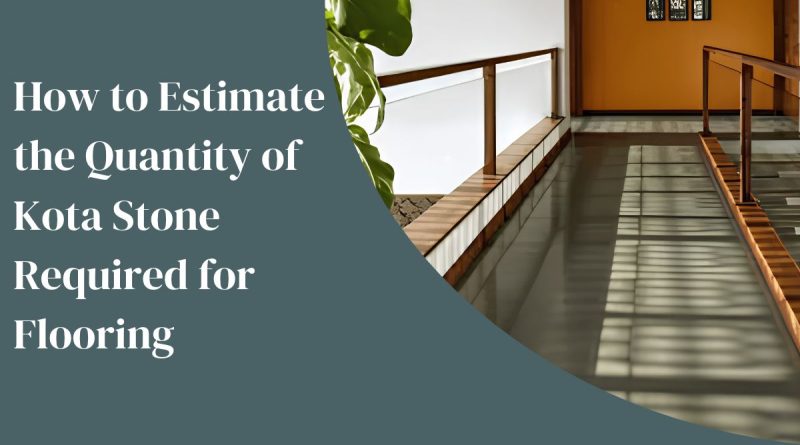
How to Estimate the Quantity of Kota Stone Required for Flooring
Kota stone is a widely used natural stone flooring material known for its durability, practical appearance, and suitability for residential and commercial construction. It is commonly installed in homes, offices, corridors, schools, verandas, staircases, and outdoor areas. However, before starting any flooring project, calculating the correct quantity of stone is essential for managing expenses, reducing wastage, and ensuring that installation work proceeds smoothly.
Accurate estimation helps homeowners, contractors, architects, and builders determine how much material to purchase according to the dimensions and layout of their spaces. Ordering too little stone can delay installation, while purchasing excessive quantities may increase the overall project cost.
In this guide, we will explain how to measure flooring areas, calculate the required quantity of stone, account for cutting waste, and choose the right stone for different applications.
1. Measure the Total Flooring Area
The first step is to measure the area where the stone will be installed. For rectangular or square rooms, you only need the length and width.
Formula:
Flooring Area = Length × Width
For example, if a room measures 15 feet in length and 12 feet in width:
15 × 12 = 180 square feet.
Therefore, the room requires 180 square feet of flooring material before accounting for cutting waste or breakage.
If you are estimating material for multiple rooms, measure each room separately and add the individual areas together. For irregularly shaped spaces, divide the floor into smaller rectangles, calculate their areas, and combine the results. Subtract large areas that will not receive stone flooring, such as permanent openings, where appropriate.
Accurate measurements form the foundation of a reliable Kota Stone Flooring estimate and help you avoid unnecessary material purchases.
2. Add an Allowance for Cutting and Wastage
Stone flooring installations often involve cutting pieces to fit corners, walls, doorways, pillars, and edges. Some wastage can also occur during transportation, handling, and installation.
For a straightforward layout, an allowance of approximately 5% to 10% is commonly used as an initial planning estimate. More complicated designs, diagonal patterns, or irregular spaces may require a higher allowance. The actual requirement depends on stone dimensions, site conditions, workmanship, and the installation pattern.
Formula:
Required Quantity = Total Flooring Area × (1 + Wastage Percentage)
For example, suppose your room measures 180 square feet and you plan for 8% wastage.
- Total flooring area: 180 sq. ft.
- Estimated wastage: 180 × 8% = 14.4 sq. ft.
- Total purchase quantity: 180 + 14.4 = 194.4 sq. ft.
You should therefore plan to purchase approximately 195 square feet, subject to the supplier’s available sizes and selling units.
This additional allowance can help reduce the risk of running short during installation.
3. Understand Stone Thickness and Available Sizes
Kota stone is available in different thicknesses and dimensions depending on the supplier and intended application. The appropriate thickness depends on the location, expected load, base preparation, and installation method.
Before ordering, discuss the intended use with your supplier or contractor. Confirm the actual length, width, thickness, finish, and tolerances of the supplied slabs.
Stone dimensions also influence the number of pieces required. For instance, larger slabs may cover more area with fewer joints, while smaller pieces may be easier to handle in compact rooms or detailed layouts.
If the supplier sells stone by square foot, your calculated area can be used directly. If the material is sold in individual pieces or another unit, convert the total area according to the actual dimensions and quantity per pack.
4. Choose the Right Kota Stone for Your Project
Different Kota stone varieties offer different colours and visual appearances. Selecting a suitable option helps you match the flooring with your property’s design and intended use.
Kota Stone Flooring
Traditional Kota stone is commonly selected for practical flooring applications in homes, offices, educational institutions, corridors, and other high-traffic spaces. Its natural appearance works well with simple and functional architectural styles.
When selecting stone, consider the surface finish, expected foot traffic, maintenance requirements, and the condition of the base. A properly prepared foundation and professional installation are important for achieving a stable and even floor.
Kota Yellow Stone
Kota Yellow Stone offers a warmer, lighter appearance that can complement traditional homes, contemporary interiors, courtyards, and selected outdoor spaces. Its yellowish tones can work well with neutral walls, wooden elements, and earthy design themes.
Before finalising the order, check the actual stone samples because natural materials may show variations in colour, texture, and pattern between batches.
Kota Honey Stone
Kota Honey stone is an option for people looking for warm honey-toned flooring. Its appearance can complement natural materials, rustic interiors, outdoor areas, and architectural designs that use earthy colours.
As with other natural stones, ask the supplier about the available finish, thickness, dimensions, and intended application. Confirming these details before purchase helps ensure that the material meets the project’s requirements.
5. Calculate the Quantity for Multiple Rooms
For properties with several rooms, the most reliable approach is to calculate each area separately.
Consider a small house with the following flooring requirements:
- Living room: 200 sq. ft.
- Bedroom: 150 sq. ft.
- Kitchen: 100 sq. ft.
- Corridor: 50 sq. ft.
Total flooring area = 200 + 150 + 100 + 50 = 500 square feet.
If you allow 8% for wastage:
500 × 8% = 40 square feet.
Total estimated purchase quantity = 500 + 40 = 540 square feet.
This estimate assumes the same stone specification throughout the property. If you choose different colours, finishes, or thicknesses for individual rooms, calculate the quantities separately for each material.
Keeping separate measurements also helps you identify where leftover pieces may be reused.
6. Account for Stairs, Corners, and Irregular Areas
Not every flooring project consists of simple rectangular rooms. Staircases, landings, narrow corridors, curved sections, and spaces around columns can make quantity estimation more complicated.
For rectangular stair treads, calculate the area of each tread by multiplying its width by its depth. Add the areas together and include risers if they will also be covered with stone.
For example, if each of 12 stair treads measures 3 feet wide and 1 foot deep:
12 × 3 × 1 = 36 square feet of tread coverage.
If the risers are also being covered, calculate their areas separately and add them to the total.
For triangular or curved areas, take detailed measurements or ask an experienced contractor to prepare a cutting layout. Complex shapes may generate more offcuts, so the wastage allowance should be adjusted accordingly.
7. Consider the Flooring Installation Method
The installation method can influence how much material is required. Stone pieces may need trimming to create straight edges, maintain consistent joints, and accommodate the room’s layout.
A skilled installer can plan the arrangement of slabs before cutting begins. This helps reduce avoidable waste and makes better use of offcuts.
The condition of the base is equally important. An uneven or poorly prepared surface can create installation difficulties and may increase the risk of breakage or uneven joints. Ensure that the subfloor and bedding method are suitable for the selected stone and the intended use.
Before ordering, discuss the layout, joint spacing, edge cuts, and finishing requirements with your contractor.
8. Estimate Your Budget Before Purchasing
After calculating the required quantity, estimate the material cost using the supplier’s current rate.
Formula:
Estimated Stone Cost = Required Quantity × Price per Square Foot
For example, if the estimated requirement is 540 square feet and the quoted stone price is ₹35 per square foot:
540 × ₹35 = ₹18,900.
This is only an illustrative material-cost calculation, not a current market quotation. Actual prices vary according to stone variety, quality, thickness, finish, supplier, and location.
Your final budget should also account for transportation, unloading, cutting, installation labour, bedding materials, finishing, and any applicable taxes. Request an itemised quotation so that you can compare suppliers fairly.
9. Check the Material Before Placing Your Final Order
Before purchasing, confirm that the selected stone meets your design and installation requirements.
Use this checklist:
- Verify the length, width, thickness, and finish.
- Inspect samples for colour and surface variations.
- Confirm the rate and unit of measurement.
- Ask about packing, transportation, and breakage policies.
- Check whether replacement material can be obtained from the same batch.
- Confirm delivery timelines and the quantity available.
- Keep a small quantity of suitable spare stone for future repairs, where practical.
Natural stone can vary from piece to piece, so checking the material before installation helps minimise unexpected differences in appearance.
Conclusion
Estimating the correct quantity of stone before beginning a flooring project helps control costs, reduce wastage, and keep installation work on schedule. Start by measuring every area accurately, add a suitable allowance for cutting and breakage, and account separately for stairs or irregular sections.
Whether you choose traditional stone, Kota Yellow Stone, or Kota Honey stone, always confirm the dimensions, thickness, finish, and pricing with your supplier. Careful planning and professional installation can help you achieve an attractive and durable floor while making efficient use of your budget.
Frequently Asked Questions (FAQs)
1. How do I calculate the quantity of Kota stone required for flooring?
Multiply the length of the floor by its width to determine the total area. Add an allowance for cutting and wastage, typically around 5% to 10% for straightforward layouts, and adjust it according to the project’s complexity.
2. How much extra stone should I order for wastage?
For a simple rectangular room, an initial allowance of 5% to 10% may be reasonable. Complicated layouts, diagonal patterns, and irregular spaces may require more. Your installer can recommend an appropriate allowance after reviewing the measurements.
3. Can I calculate Kota stone requirements for an entire house?
Yes. Measure each room, corridor, staircase, and other area separately. Add the measurements together, then calculate the additional material required for cutting and wastage. Calculate different stone varieties separately.
4. What factors affect the cost of Kota stone flooring?
The cost depends on the stone variety, quality, dimensions, thickness, surface finish, transportation, installation labour, cutting requirements, and local supplier rates.
5. Is Kota Yellow Stone suitable for residential flooring?
Kota Yellow Stone may suit many residential flooring projects, depending on the selected finish, installation method, and intended application. Check samples and consult your contractor before choosing a product for a particular space.
6. What should I check before buying Kota Honey stone?
Confirm its colour, thickness, dimensions, surface finish, quality, price, and availability. Inspect samples and discuss the intended application with your supplier.