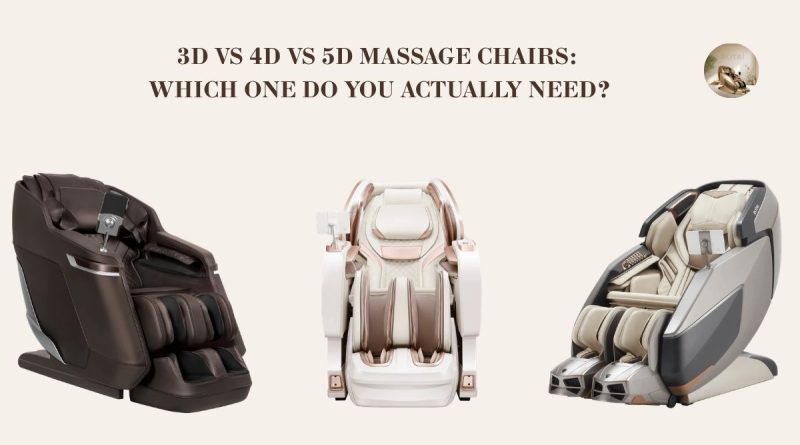
3D vs 4D vs 5D Massage Chairs: Which One Do You Actually Need?
If you set out to buy a massage chair today, you will encounter a variety of confusing terms or numbers—such as 2D, 3D, 4D, and even 5D. Companies often present these numbers as a hierarchy where a higher number implies a superior product. However, the reality is somewhat different; spending more on a chair with a higher rating does not necessarily guarantee a better experience for your body.
This guide explains what these labels actually mean, what it feels like to use each type of chair, and which one is the right choice for your specific needs and budget.
What Do “3D,” “4D,” and “5D” Actually Mean?
Here’s the first thing to know: there’s no universal industry standard for these terms. Different brands use them slightly differently, so treat them as a rough guide rather than a precise specification. That said, the general meaning is as follows.
The “D” refers to the dimensions of movement the massage rollers can achieve:
- Up and down along your back (2D chairs)
- Left and right across the muscles
- Forward and backward, meaning how deeply the rollers press into your body
The more dimensions, the more control and variety the chair has in how it works your muscles.
3D Massage Chairs: Adjustable Depth
A 3D massage chair has rollers that move up and down, side to side, and can also extend outward to press deeper into the body. This is where you gain control over intensity, usually in several levels, from gentle to firm.
What it feels like: A noticeable improvement over basic chairs. The massage feels less flat and more like a person pressing into your muscles.
Best for:
- First-time buyers who want a quality massage without a premium price
- People who prefer moderate, predictable pressure
- Households where several family members need different intensity settings
Limitations: The movement pattern tends to be more uniform. Some users find it repetitive over time, and it may not be strong enough for people with dense, knotted muscles.
4D Massage Chairs: Added Speed and Rhythm
A 4D massage chair builds on 3D by adding variation in speed and rhythm. The rollers don’t just press; they change tempo, pause on pressure points, and mimic the pacing of a therapist’s hands.
In some brands, the fourth dimension also refers to a time or flow element: the sensation of the massage building, easing, and shifting naturally rather than running on a fixed loop.
What it feels like: More dynamic and more human. Strokes feel varied rather than mechanical, and you’re less likely to get bored mid-session.
Best for:
- Regular users who want a more engaging massage
- People with desk jobs who deal with stubborn shoulder and upper back tension
- Buyers ready to spend a bit more for a noticeably smoother experience
Limitations: Because brands define the fourth dimension differently, two “4D” chairs can feel quite different. Don’t rely on the label alone.
5D Massage Chairs: Precision and Customization
The fifth dimension is the least standardized of all. When brands use the term 5D massage chair, they usually point to some combination of the following:
- Advanced body scanning that maps your shoulders, spine, and body shape
- More precise roller control, such as targeting specific points or slowing down on tight areas
- Higher customization, including saved profiles and finer intensity adjustments
- Smoother, more fluid motion from upgraded motors and mechanisms
What it feels like: The most personalized experience. The chair adapts to you rather than the other way around.
Best for:
- Frequent users, or households with multiple users of different body types
- People with specific problem areas who want targeted work
- Buyers who view the chair as a long-term wellness investment
Limitations: It’s the most expensive tier, and the marketing label can be applied loosely. A “5D” chair with a weak motor can still underperform a well-built 4D model.
Side-by-Side Comparison
|
Feature |
3D | 4D |
5D |
| Roller movement | Up/down, side-to-side, adjustable depth | Adds speed and rhythm variation | Adds precision, scanning, and customization |
| Massage feel | Controlled, fairly uniform | Dynamic, more natural | Highly personalized |
| Typical price positioning | Mid-range | Upper mid-range | Premium |
| Ideal user | First-time buyers | Regular users | Frequent or multi-user households |
| Customization | Moderate | Good | Extensive |
Pricing and features vary by brand and model.
Do You Actually Need the Highest Number?
Honestly, not always. Here’s how to think about it:
Choose 3D if you’re buying your first chair, your budget is limited, or you simply want regular relaxation after a long day.
Choose 4D if you plan to use the chair often, want a more engaging massage, and are comfortable spending more for a better feel.
Choose 5D if you want maximum personalization, several people will use the chair, or you have specific areas that need focused attention.
For many Indian households, a well-built 3D or 4D chair is the practical sweet spot. The extra cost of 5D is worth it mainly when you’ll use the added precision regularly.
What Matters More Than the “D” Number
The dimension label is only one part of the picture. Several other factors shape how good a chair really is:
Roller Track Type
An L-track or SL-track extends the massage down to the glutes and upper thighs, which many people with sedentary jobs find far more useful than an extra “D.” A basic S-track limits coverage regardless of the dimension rating.
Full Body Coverage
If you want relief beyond the back, look for a full body massage chair with air compression in the arms, calves, and feet, plus foot rollers. A 5D chair that only works on the back may deliver less overall value than a 3D full body model with excellent leg and foot coverage.
Body Fit
Check the recommended height range and adjustability of the leg rest and shoulder position. A chair that doesn’t fit you won’t massage the right spots, no matter what the label says.
Motor and Build Quality
Strong motors and solid frames determine how the chair feels after a year of use. Ask about warranty coverage on the motor, rollers, and electronics separately.
Extras Worth Having
Heat therapy, zero gravity recline, and quiet operation add real comfort. Bluetooth speakers and app control are nice but secondary.
How to Test a Chair Before Buying
- Try it in person if possible. Spend at least 10 to 15 minutes, not just a quick sit.
- Test several intensity levels. A good chair should feel comfortable at low settings and effective at higher ones.
- Check the roller reach. Make sure it covers your shoulders and lower back properly.
- Listen for noise. Loud mechanics break the relaxation.
- Compare two or three chairs back to back across different “D” ratings. You may find you prefer the feel of a lower-rated model.
Common Mistakes Buyers Make
- Assuming a higher number always means better quality. Build and design matter more.
- Overspending on features you won’t use.
- Ignoring service support. Availability of local technicians is crucial in India.
- Skipping the space check. Reclining chairs need clearance behind them, and doorways and lifts need to accommodate delivery.
- Believing marketing claims blindly. Ask the seller what the “D” rating specifically means for that model.
Final Verdict
The “D” label is a helpful starting point, but it shouldn’t be the deciding factor. A 3D chair suits most first-time buyers, a 4D chair rewards regular users with a more natural feel, and a 5D chair makes sense when precision and personalization matter to you.
Whatever you choose, prioritize roller track type, body fit, build quality, and after-sales support. Try before you buy whenever possible, and let how the chair feels on your own body guide the final call.
Frequently Asked Questions
Is a 5D massage chair always better than a 3D one?
Not necessarily. Since there’s no standard definition, a well-built 3D chair can outperform a poorly made 5D one. Compare actual features and test the feel.
What’s the main difference between 3D and 4D?
Generally, 3D adds adjustable depth to the rollers, while 4D adds variation in speed and rhythm for a more natural, therapist-like feel.
Which type is best for back pain?
There’s no single answer, and a massage chair isn’t a treatment for medical conditions. People with persistent back pain should consult a doctor first. For general muscle tension, a chair with good roller depth control and an L-track often works well.
Is a full body massage chair worth it over a back-only model?
If you want relief across the legs, arms, and feet as well as the back, yes. Coverage often matters more than the dimension rating.
How long can I use a massage chair each day?
Most people use one for 15 to 30 minutes. Follow the manufacturer’s guidance.